
Category Archives: Community Platform
Community Platform: Invitation to Tender
Reviewing and analysing the structures, role and operation of the Community Platform
Founded in 1996, the Community Platform is an alliance of national networks and organisations in the community and voluntary sector working to address poverty, social exclusion and inequality. The Community Platform was set up to be a collective critical voice for equality, rights and anti-poverty interests at a national level.
The main activities of the Platform are:
- Mutual solidarity, sharing information training and discussion.
- Developing joint policies, positions and publications.
- Promoting policies through participation in national structures (such as the Community and Voluntary Pillar), liaising with Government Ministers and Departments and through public statements.
Membership
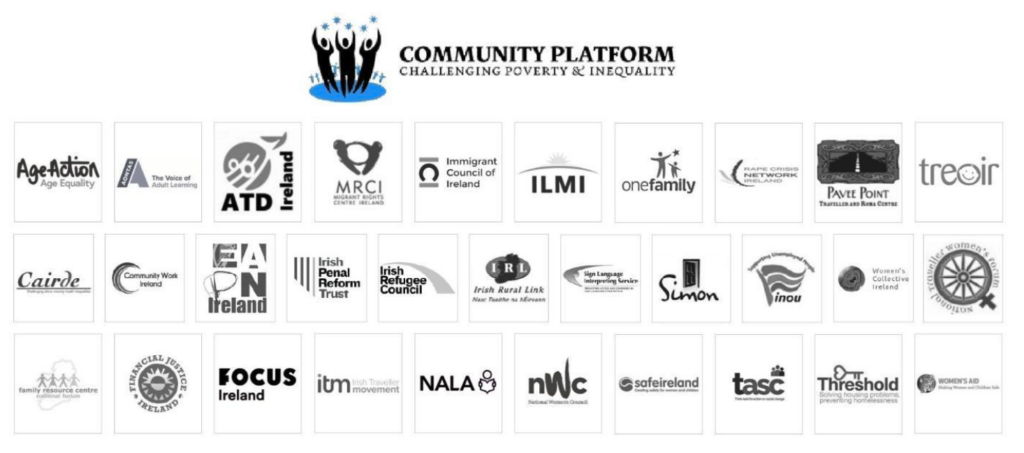
The Platform is currently made up of 31 national organisations (below)
Membership is open to national organisations whose main focus is on representing the interests of those living in poverty, social exclusion and inequality. Priority is given to organisations working from the values of principles of dignity, economic equality, participation, social justice, solidarity and sustainability.
Secretariat
The secretariat of the Community Platform is currently Community Work Ireland (CWI), which is responsible for carrying out its administrative functions.
The Community Platform is one of the 17 members of the Community and Voluntary Pillar and receives a small grant from the Department of Rural and Community Development.
Tender
The Community Platform is seeking a suitably qualified consultant(s) to:
- Undertake a review of the Community Platform’s structure, role and remit.
- Analyse the context in which the Community Platform is operating and the challenges and opportunities presented by that context.
- Assess members’ perspectives on the role of the Community Platform in relation to collaborative governance and its engagement in current structures and processes.
- Review the membership including gaps and where membership could be expanded.
- Set out possible funding strategies.
- Produce a written final report with recommendations.
- Present the final report to the Community Platform Members.
The budget for the project inclusive of VAT and expenses is €7,000.00
Consultant(s) Specifications
The successful candidate will have:
- Proven evidence of experience as a researcher in the community sector.
- Knowledge of the historical and current context in which the Community Platform is operating
- Excellent presentation, communication, facilitation and writing skills.
Timeline
Commencing October 2026, final outputs by end January 2027 and interim targets to be agreed with the Community Platform.
Tendering Process
Interested parties are invited to submit:
- A detailed outline of the proposed approach
- Brief details of experience, previous similar work undertaken and reference, including a CV of the individual/s making the proposal
- Costing and indicative timescale.
Deadline
Tenders to be submitted by e-mail to communityplatform@cwi.ie, subject line Tender Community Platform Review by 21st September. Queries by email should be directed to communityplatform@cwi.ie
Assessment Process
Tenders received will be assessed on the basis of the following award criteria:
Award Criteria / Marks Available
- Demonstrated knowledge and understanding of the brief / 25
- Approach/methodology / 25
- Experience in community development and a track record in similar work / 25
- Availability to carry out the project within the stated timeframe / 10
- Value for Money / 15
All materials developed will remain the property of the Community Platform.
More information about the Community Platform can be found here:
- Website: https://communityplatform.ie/
- Instagram: Community Platform (@communityplatformirl) • Instagram photos and videos
- Linkedin: Community Platform: Posts | LinkedIn
Phone: +353(0)86 822 6210
Report: ‘What Would it Take to Eliminate Consistent Poverty by 2030?’

COMMUNITY PLATFORM CALLS ON ALL POLITICAL PARTIES TO COMMIT TO ELIMINATING POVERTY BY 2030
The Community Platform, an alliance of 31 national networks and organisations in the community and voluntary sector, has today called on all political parties to commit to the elimination of consistent poverty, as it launched its new report, ‘What Would it Take to Eliminate Consistent Poverty by 2030?’.
Drawing on the collective expertise of the Platform’s members – 31 leading organisations in the community and voluntary sector working to address poverty, social exclusion and inequality – the report provides key insights into the root causes and structural reasons for consistent poverty, and the groups most commonly affected. Crucially, it identifies key solutions and provides recommendations to eliminate consistent poverty.
“This is a critical moment to make the eradication of poverty a political priority. Budget 2025 will be the final budget of the current Government, and a General Election is just around the corner. The Community Platform calls for all Budget measures to be assessed to ensure they reduce poverty, and for all political parties to commit to the elimination of consistent poverty as a key priority ahead of the General Election. The report shows it is possible to eliminate consistent poverty by 2030, but it will need a high level of political commitment,” said report author, Dr Nat O’Connor (Age Action/UCD School of Social Policy, Social Work and Social Justice).
“Ireland has a national target to reduce ‘consistent poverty’ to 2% or less by 2025. The Community Platform believes this official target does not go far enough. Why not aim for zero, as was the stated national policy in 2002 and 2007? Seeking to eliminate consistent poverty by 2030 would say that we want Ireland to be a country that does not leave anyone behind. We need a national anti-poverty strategy based on the goal of eliminating consistent poverty, one that acknowledges and addresses the structural reasons some people are more likely to be in poverty,” said Dr O’Connor.
Dr O’Connor continued: “The range of measures need to achieve the goal of eliminating consistent poverty by 2030 will need to address income adequacy for everyone, access to a decent work for those who can work, and routes out of poverty for those unable to secure an adequate income from work or who are unable to work. Greater investment is needed to ensure access to quality, affordable and sustainable public services for all, irrespective of income level. Tackling and lowering wealth inequality will be crucial, including through progressive taxation.”
Download the full report, ‘What Would it Take to Eliminate Consistent Poverty by 2030?’
COMMUNITY PLATFORM RESPONSE TO UN COMMITTEE ON ECONOMIC SOCIAL & CULTURAL RIGHTS CONCLUDING OBSERVATIONS ON IRELAND
UN HIGHLIGHTS SERIOUS CONCERNS WITH IRELAND’S ECONOMIC, SOCIAL AND CULTURAL RIGHTS RECORD
The UN Committee on Economic, Social and Cultural Rights findings on Ireland highlight key issues the State must address if it is serious about tackling poverty and social exclusion and protecting the economic, social and cultural rights of the most marginalised and disadvantaged groups in society, the Community Platform said in response to the UN Committee on Economic, Social and Cultural Rights (UN CESCR) publishing its concluding observations on the fourth periodic report of Ireland.
The Community Platform, an alliance of 31 leading organisations in the Irish community and voluntary sector, made a submission to and engaged with the Committee ahead of its review of Ireland, to provide it with a vital alternative perspective on Ireland’s economic, social and cultural rights landscape. The concluding observations reflect many of the key concerns the Platform raised during the periodic review process, including the need for the State to tackle discrimination, address the structural causes of poverty and barriers to social inclusion, to guarantee income adequacy for all, to address deficits in the provision of a range of services including housing, health and care, to improve its engagement with affected communities and the organisations that represent them in the policy process, and the critical role of data and evidence for policy.
“The Committee has highlighted the urgency of ensuring everyone has an adequate income for a decent life, whether this is from work or social welfare, or a mix of both. A key recommendation is that both wages and social welfare supports be linked to the cost of living. It also recommends a review of conditions that affect people’s access to social welfare and the removal of any that are discriminatory, as well as improving the take-up of supports. The Committee also calls on the Government to tackle the barriers causing many groups and communities in society to have unequal access to decent work,” said Paul Ginnell, Director of the European Anti-Poverty Network (EAPN) Ireland.
“A key concern for the Community Platform is engagement with affected communities, and the organisations that represent them, in the design and implementation of policy. We welcome the Committee’s recommendation that the Government must ensure the participation of civil society in the policy process, through meaningful and effective engagement at all stages, beyond just information and consultation, particularly the recognition that policies affecting disadvantaged and marginalised individuals and groups must be developed, monitored and evaluated in partnership with them,” said Ann Irwin, National Co-ordinator with Community Work Ireland.
“We welcome the Committee’s calls for Ireland to effectively tackle discrimination, stigma, and the structural and institutional barriers and exclusion faced by disadvantaged and marginalised groups. We are particularly heartened by the Committee’s recommendations that the Government include socio-economic status as a ground in Irish equality legislation, address the gender pay and pension gaps, and ensure targeted supports for groups disproportionately affected by poverty and social exclusion,” said Bríd O’Brien, Head of Policy and Media at the Irish National Organisation of the Unemployed (INOU).
ENDS/
For more information or to arrange an interview, please contact:
Tim Hanley, email: communityplatform@eapn.ie
NOTES:
- The Committee on Economic, Social and Cultural Rights Concluding Observations on Ireland are available here.
- The UN Committee on Economic, Social and Cultural Rights (UN CESCR) is the body of that monitors implementation of the International Covenant on Economic, Social and Cultural Rights by its State parties. The Covenant enshrines economic, social and cultural rights such as the rights to an adequate standard of living, adequate housing, education, health, social security, and work.
- The Community Platform Submission to the Committee on Economic, Social and Cultural Rights Fourth Periodic Review of Ireland is available here.
- Community Platform spokespersons: Paul Ginnell, Director, EAPN Ireland; Bríd O’Brien, Head of Policy and Media, Irish National Organisation of the Unemployed (INOU); Ann Irwin, National Co-ordinator, Community Work Ireland.
- The Community Platform Submission contains dedicated chapters with recommendations and proposals for engagement for effective policy and strategy design and implementation; the need for Government to be accountable for its decision-making; the use of data in informing effective policy implementation, as well as putting forward suggestions for Questions for the Committee to put to the Irish Government. The submission also drills down and addresses key articles in the Covenant on Economic, Social and Cultural Rights in the Irish context, along with recommendations for each:
- Article 2.1: Maximum Available Resources
- Article 2.2: Non-Discrimination
- Article 3: Equal Rights of Men and Women
- Article 6: Right to Work
- Article 7: Right to Just and Favourable Conditions of Work
- Article 9: Right to Social Security
- Article 10: Protection of the Family and Children
- Article 11: Right to an Adequate Standard of Living
- Article 13: Right to Education
- Article 27: Ethnic and Linguistic Minorities
- Article 12: Right to Physical and Mental Health
- Article 26: Right to Equality Before the Law
- Article 24: Rights of the Child
- Article 20: Prohibition of Incitement to Hatred